AEI Car Tracing
One of the major challenges facing all railroads over the years has been the tracking of cars as they move from origin to destination. Not only is it vital for the customer to know where his shipment is and when it may be expected to arrive, but it is also essential that the railroad be able to locate its car supply in order to meet shipper needs.
In the earlier days of railroading, train and yard crews listed cars as trains moved past observation points, and office crews received this information and passed it along as needed.
This was a totally manual process, except where teletype transmission could be used, and was cumbersome and inefficient, although quite accurate. As trains grew in length and the number of people in position to observe began to shrink, it became obvious that the record keeping would become insufficient as well as inaccurate. The problem became acute as industry adopted “just in time” delivery requirements and utilized the transit vehicle as the warehouse.
The Automatic Car Identification system, “ACI”, which utilized optically scanned labels to identify the individual car, was the first industry-wide attempt to electronically address the car location question. Scanners were located at strategic points and automatically read car identification marks into the transmission system and data could thus be distributed for use. Label condition was critical to accurate data collection, and it was quickly discerned that label maintenance would not be of high enough caliber to permit ACI to meet all of the needs, and the industry discontinued its use. It should be noted that the same optical scan system was subsequently adapted for use in pricing and inventory control of consumer goods, and is in widespread and successful use in our stores.
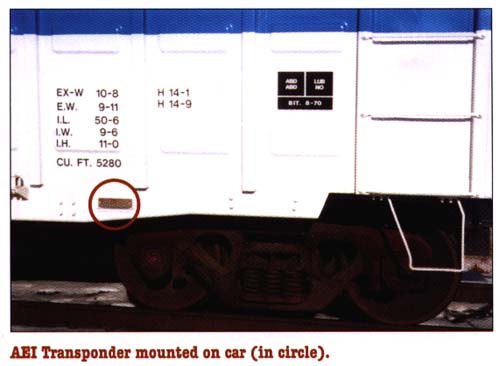
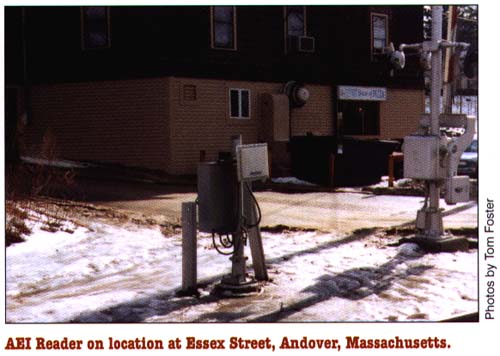
With the widespread development of solid state circuitry, computer-aided data collection and sophisticated telecommunications, the Automatic Equipment Identification system (“AEI”), described briefly in the previous issue of the “Xpress”, came into existence and has been adopted by the railroad industry as the means of solving the car location problem. There are two primary elements in this system: the transponder, or “tag”, and the trackside reader. The transponder is “passive”, which means it is non-powered. It consists of an electronic strip capable of storing 128 “bits” of information, and is encased in a weatherproof polycarbonate housing. A specially programmed personal computer is used to input car initials and number, capacity and ownership information into two tags, and one is mounted on each side of each car (and locomotive, if desired). The readers are located in pairs, one on each side of the track, and are energized only when a train occupies the track circuit. The reader sends a radio signal to the car which activates the electronic strip in the tag; the tag transmits its stored information back to the reader, which collects the data and then transmits it via modem to a networked personal computer. At Guilford Rail, the data is received in North Billerica and connected to the main AS400 computer where it is matched with waybill information and then distributed to the users.
One of the most useful aspects of the AEI system is the opportunity to confirm that the entire train has passed the reader location. A tag installed on the Rear End Marking Device, which is required on the rear of each train, will transmit its unique data through the reader and the train operations people thus receive an exact fix on the entire train. With that information, the dispatcher is able to make other train movements on the track just vacated.
Customer access to car location information has been enhanced by the use of the Internet to provide the location data made available by the AEI system. By navigating on the Internet to
www.guilfordrail.com, 24 hours a day, the customer can click on “Car Tracing”, enter his car initials and number and be informed as to the last known location on Guilford Rail of his car. With this capability, and the use of the thirteen readers in service on Guilford Rail, it can be said that the question of car location has been answered. Additional readers are planned for 1999 installation at strategic locations.