
As Part of a Five-Part Series,
"Railroading, Proud Past - Hopeful Future"
Maine's Central Morning Newspapers
gave an overview of how railroads, particularyly
Guilford Rail System, helped shape Central Maine Industry,
Infrastructure and its People.
In a cavernous brick building at the Guilford Rail System yard here, Richard Alexander was readying a washing-machine-sized generator for reinstallation in locomotive 643.
Nearby, David Simpson was rebuilding traction motors, while in the wheel shop, a short distance away, machinist Rick Huard was reshaping freight-car wheels on a massive lathe, which peeled off steel ion shiny ribbons.
Through a sliding door was the blacksmith shop, complete with forge, where three blacksmiths produce brake rigging and other parts.
"There's nothing that we can't make if we need to," said shop superintendent Jim Patterson. "We just try to make sure it's cost-efficient now. If we can buy a bolt for 30 cents, we don't spend $3 making it."
The engine house features a lift with a 100-ton capacity, allowing it to lift an entire locomotive from the ground. A smaller lift is used to pull locomotive components; its capacity is 35 tons.
In the engine house that morning, three of the railroad's 130 diesel electric locomotives were pulled into bays for servicing. According to Locomotive Manager Jim Lancaster, Locomotive 681 was being rebuilt, its 20-cylinder diesel motor was removed and dismantled.
The engine block is roughly 6 feet high by 12 feet log. The pistons are 91/2-inch cylinders. This, Lancaster said, is the same motor that powered ocean-going tugboats he worked on for Texaco.
It is specialized work that requires special skills, he said, and all the workers, including some who transferred to Maine from other Guilford locations, are specialists.
Huard, working at the wheel lathe, said he’s been at the shop for 24 years. Asked how many rail car wheels he’s reshaped in his career, Haurd smiled as the metal peeled from the wheel’s flange. “Quite a few,” he said.
That expertise has earned the shop certification from the American Association of Railroads, Lancaster said. That designation allows the shop to do contract work for other railroads.
Rail Important to Paper Industry
Maine’s paper industry and its rail lines literally grew up together over the last century and a half, their fates intertwined. And it’s a bond that has lasted in spite of the growing influence of trucks and the corresponding shrinkage of the rail network.
Virtually all the state’s paper and pulp mills depend on the rail lines to some extent to bring raw materials to their plants and to get their product to customers.
“We’d be out of business without the rail service,: said Douglas Daniels, the mill manager at Sappi Ltd’s S.D. Warren mill in Skowhegan.
Adam Sterns, customer service and logistics manager at Madison Paper Industries, echoed that sentiment. “The rail is really very important to us at this mill,” he said.
Mills vary in the extent to which they depend on rail lines for bringing in raw materials and shipping product. Factors ranging from mill location to the plant’s customer base influence decisions on transportation methods.
Like others of the state’s craft mills, Warren’s Somerset Mill gets raw materials by rail. Things like clays from Georgia and Vermont and chemicals used in the pulp making process.
“Virtually everything we get in here, with the exception of the fiber, we can get by rail,” said Daniels.
“The Warren mill ships 60 percent of its product by rail, and would like to boost that to 80 percent,” Daniels said. The remaining 40 percent goes by truck.
“Our average shipment from this mill is over 1,600 miles. Obviously if you can ship by rail, rather than truck, there should be economic advantages to that,” Daniels said.
“Warren’s use of intermodal, or ‘piggyback’ shipments, where loaded trailer trucks are transported on rail cars to a point near their final destination, grew for several years, but has now stabilized,” said Daniels.
Daniels said “If a Somerset Mill customer can accept rail shipment, the mill prefers to send by rail. If the customer can’t, the choice is between direct truck and intermodal.”
“MPI already uses rail extensively to ship its paper and would like to see 85 percent of it leave the mill by rail,” said Stearns. “Since about the beginning of 1996 we have really tried to commit to shipping as much as possible by rail.”
“MPI’s customers - mainly large printing houses - would rather get one boxcar full of paper than three truck loads,” Stearns said.
“The rail is really very important to this mill,” Stearns said. “For the last two to four years we’ve been working to develop a relationship with the rails that serve us, to make them more like partnerships than business transactions.”
Intermodal
Colin Pease, executive vice president of Guilford, says an average of 50 to 60 truck a day pass through the Intermodal Terminal, including both inbound and outbound traffic.
Schneiderr National, J.B. Hunt Transport, and C.H. Robinson are among the big trucking companies that use the facility, transporting mostly paper and forest products to the market, according to Pease. But others have expressed interest.
Pease said that smaller trucking firms also benefit from the intermodal service. He explained that bigger companies act as brokers for independent truckers, who make the short hauls after the products are removed from the trains.
According to Robert Elder, director of the Office of Freight Transportation for the Maine Department of Transportation, Guilford’s relationship with Conrail is changing. “Two large, private railroads are negotiating to buy Conrail and split it up,” he noted.
“Norfolk Southern Co. And CSX Rail are working through the U.S. Surface Transportation Board to reach an agreement,” he said. “We’d like both of them to connect, to offer competitive bids,” Elder said. “This affects all of New England and the Mid-Atlantic.”
Pease said that the merger of conrail with the two othe railroads is promising because it would offer access to more markets. “I feel we have been very successful,” he said. “What we have proven is that the market is there and the potential for growth is very definitely there.”
Staff Writers Joe Rankin and Gerry Boyle
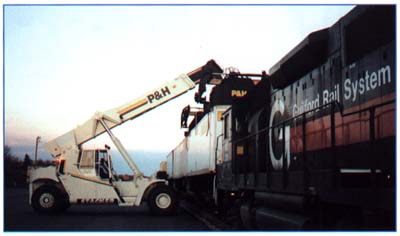
Smaller trucking firms also benefit from the intermodal service. Bigger companies act as brokers for the independent truckers, who make the short hauls after the products are removed from the trains.