Constructing a Solution
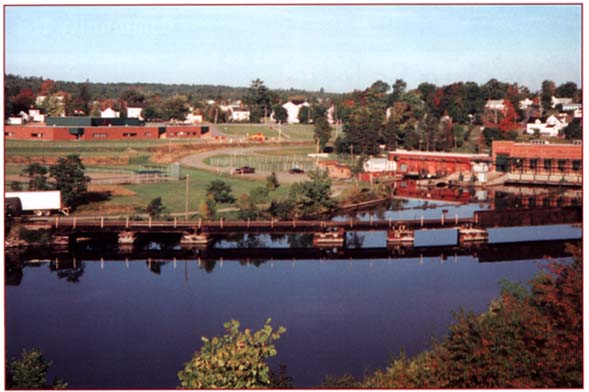
"Granted Deed in the 13th year of the Reign of her Majesty, Queen Victoria" and given a makeover in this, the first year of Fred the Donut Man's retirement, the bridge running from Calais, Maine to St. Stephen, New Brunswick, Canada serves as an example of the many challenges a bridge repair project can pose.
Built around 1852, the six-span, five pier bridge is planted firmly in both Canada and the United States. Since its construction, its piers had deteriorated with age and worn down from large sheets of ice flowing down river during the spring thaws.
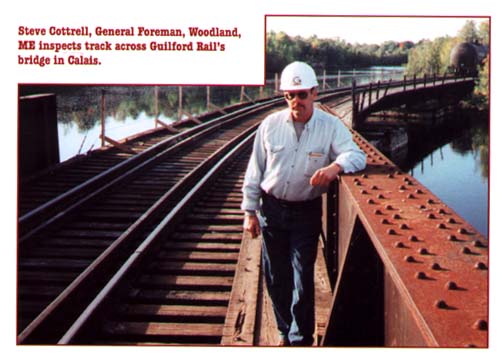
Repairs to the bridge were performed annually, with crews typically replacing worn timbers. Working within an unusually limited time frame to attain the proper permits and complete the work, Guilford Rail's engineers looked to develop a more permanent solution to the bridge's problems.
Several alternative designs were proposed. Many were too costly and others too short term. Everything from replacement to relocation of the bridge was considered. It was decided that if the timber crib piers and abutments were filled with concrete, the solid mass would support the bridge, giving it a minimum 30-year repair. The biggest obstacle in this project didn't prove to be moving timbers or pouring concrete, but cutting through red tape.
Over the course of two months Guilford Rail found out just what it takes to shut down a dam and shut off a power source for the New Brunswick Power Co. along with restricting the flow from the Georgia Pacific factory dam and lowering an international river for 14 days. Guilford had to coordinate almost 30 permits from a diverse collection of governmental agencies representing Canada, the Province of New Brunswick, Border Patrols, Customs, Canadian Coast Guard, United States Army Corps of Engineers, etc.
This walk through the maze of paperwork was made smoother with the help of Maine DOT Commissioner John Melrose as well as Ms. Lee Sochasky, of the St. Croix International Waterways Commission, who helped cut through a litany of Coast Guard permits.
Once the permitting process was completed, Guilford Rail and F.E.S. Contractors out of Everett, MA could get to work.
The initial phase of the project had to be performed during the two-week window allowed for the lowering of the St. Croix River. During this phase of construction, concrete was pumped on five separate occasions into each pier and abutment. To prevent any further shifting from its bank, the U.S. abutment was stabilized by four horizontal tie rods anchored to bedrock.
With this long-term fix it should be quite a while before our engineers get up early muttering, like Fred, "time to fix the bridge."
For every environmental agency dealt with in the U.S., its Canadian counterpart also had to be contended with, as well as all border and international commissions.